
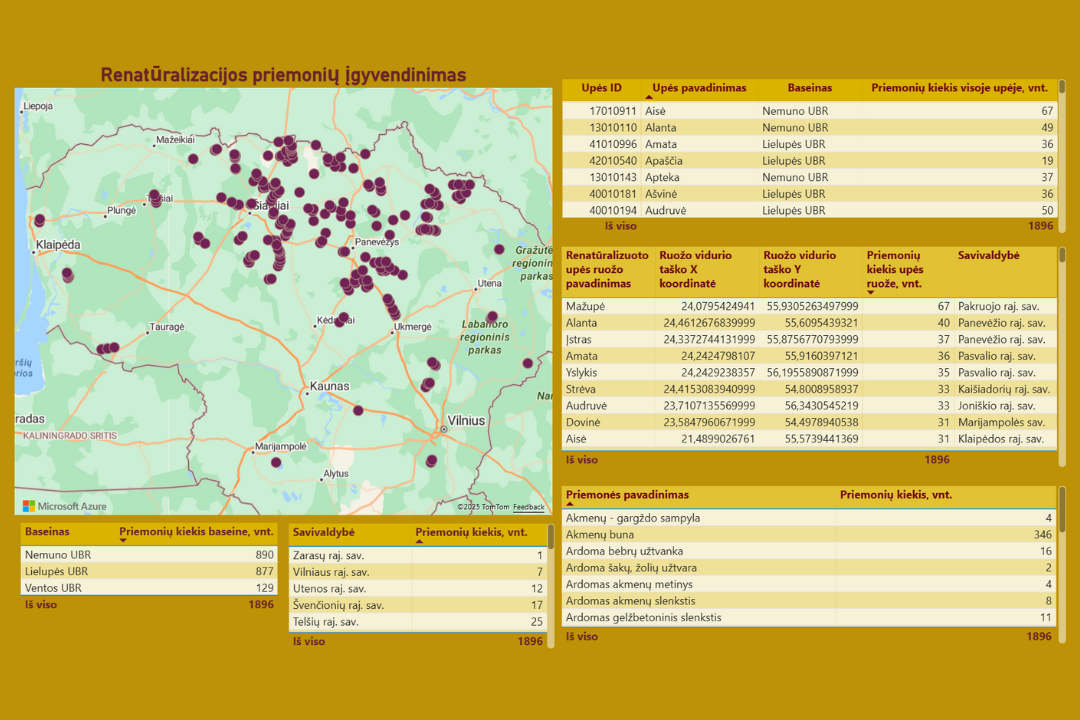
Specialists of the Hydrographic Network Division of the Environmental Protection Agency have prepared a digital map showing the soft renaturalisation measures installed in Lithuania’s rivers and streams to improve their ecological status.
Between 2017 and 2022, the Environmental Protection Agency implemented soft renaturalisation measures covering as much as 1,500 km of water stretches. These measures were installed so as not to change the channel trajectory or cause major bank erosion, not to affect adjacent private plots, not to disrupt the operation of drainage systems or interfere with drainage maintenance works, not to reduce channel capacity during peak flows (rainfall, snowmelt), not to critically reduce the possibilities for channel and slope maintenance, and not to obstruct the migration of fish and/or other animals.
The map shows the name and coordinates of each renaturalised river stretch and provides detailed information on which renaturalisation measures were implemented in a given stretch and in what quantity, as well as how many renaturalisation measures have been implemented in each municipality.
Soft renaturalisation – a way to improve the ecological status of rivers and streams
Soft renaturalisation refers to measures aimed at improving the ecological status of regulated rivers and streams; they are applied in many EU countries, including Lithuania.
In the 1960s–1980s, in order to adapt as much land as possible to agriculture and increase field productivity, rivers and streams in Lithuania were quite intensively regulated, deepened, straightened and re-engineered. Many streams were turned into ditches designed to drain water from land-reclamation systems as quickly as possible.
Over time, intensive land-reclamation processes had a marked negative impact on the ecosystems of Lithuania’s rivers. The regulation of streams and their conversion into drainage ditches fundamentally altered natural channel processes and the water balance of rivers, and reduced to a minimum the diversity and abundance of natural habitats and of the aquatic plants, benthic fauna and fish living in them. These processes also degraded the natural self-purification of streams, which is why water quality indicators in most straightened rivers do not meet the requirements for good ecological status.
To improve the ecological status of rivers and streams, many EU countries, including Lithuania, already use so-called soft renaturalisation measures in regulated rivers – forming riffles, backwaters, pools and sills in the river channel and modifying its cross-section using natural materials such as stones, gravel and wood. Renaturalisation measures also include planting trees on channel slopes or banks and diversifying river flow.
The map is available here.