
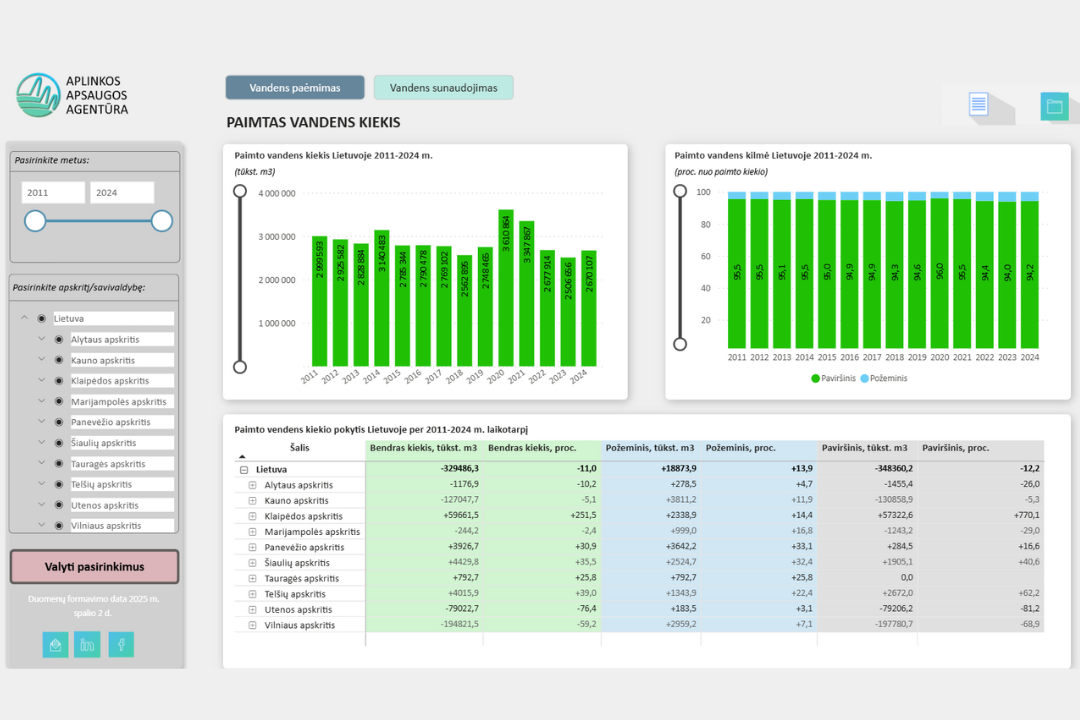
Specialists at the Environmental Status Analytics Centre of the Environmental Protection Agency (EPA) have prepared a new interactive dashboard presenting the latest data on water abstraction and consumption in Lithuania.
Monitoring the abstraction and use of water resources is an essential tool for assessing whether water abstraction and consumption are sustainable, whether ecosystem limits are being respected and whether their long-term condition is being preserved.
The dashboard presents information on the amount of water abstracted and its distribution by origin, as well as the amount of water consumed and its distribution by sector of activity. The data cover the period 2011–2024 and are presented at the national, county and municipal levels, making it possible to see indicator trends over this period at the chosen level.
The amount of water abstracted is decreasing
Both surface water and groundwater are used to meet Lithuania’s water needs. Water is used not only for the needs of society and ecosystems but also in the water, food, energy, industry and transport sectors.
Comparing the 2011–2024 data, the total amount of water abstracted is decreasing: in 2024, a total of about 2.6 billion m³ of water was abstracted, about 11% less than in 2011.
By origin, most of the water abstracted in Lithuania is surface water. The percentage ratio of surface water to groundwater abstraction remained similar throughout the analysed period: about 95% and about 5%. Fluctuations of 1–2 percentage points reflect an observed trend of increasing groundwater abstraction and decreasing surface water abstraction. Compared with 2011, groundwater abstraction in 2024 increased by about 14% and accounted for 6% of total water abstraction, while surface water abstraction decreased by about 12% and accounted for 94% of the total.
Most of the water abstracted is fresh water from rivers, lakes, ponds and other surface water bodies, as well as precipitation water. A smaller share is non-fresh water from the Curonian Lagoon, where water mixes with the Baltic Sea, and from the Baltic Sea itself. Groundwater abstraction is also dominated by fresh water, with the remainder being mineral water.
The energy sector consumes the most water
The amount of water abstracted is directly determined by water use needs. The data show that in 2024 most water was consumed for energy needs (about 94%). Fluctuations in the amount of water abstracted depend largely on the operation of the Kruonis pumped-storage hydroelectric plant, which pumps water from the Kaunas Reservoir into an artificial reservoir and uses it to generate electricity.
Meanwhile, households accounted for about 7%, industry and fisheries for about 2%, and agriculture and forestry for just over 1% of all water consumed.
The structure of water consumption has also changed. Compared with 2011, total water consumption increased in the agriculture and forestry sector (>100%), and increases were also observed in industry and the household sector (37–73%). Meanwhile, the energy and fisheries sectors saw a decrease of about 15% in water consumption.
Decreasing water abstraction and more sustainable technologies are reducing pressures on water ecosystems. Lithuania is among the countries at low risk of water scarcity, but its long-term dependence on surface water for energy makes it sensitive to the effects of climate change.
The dashboard is available here.