
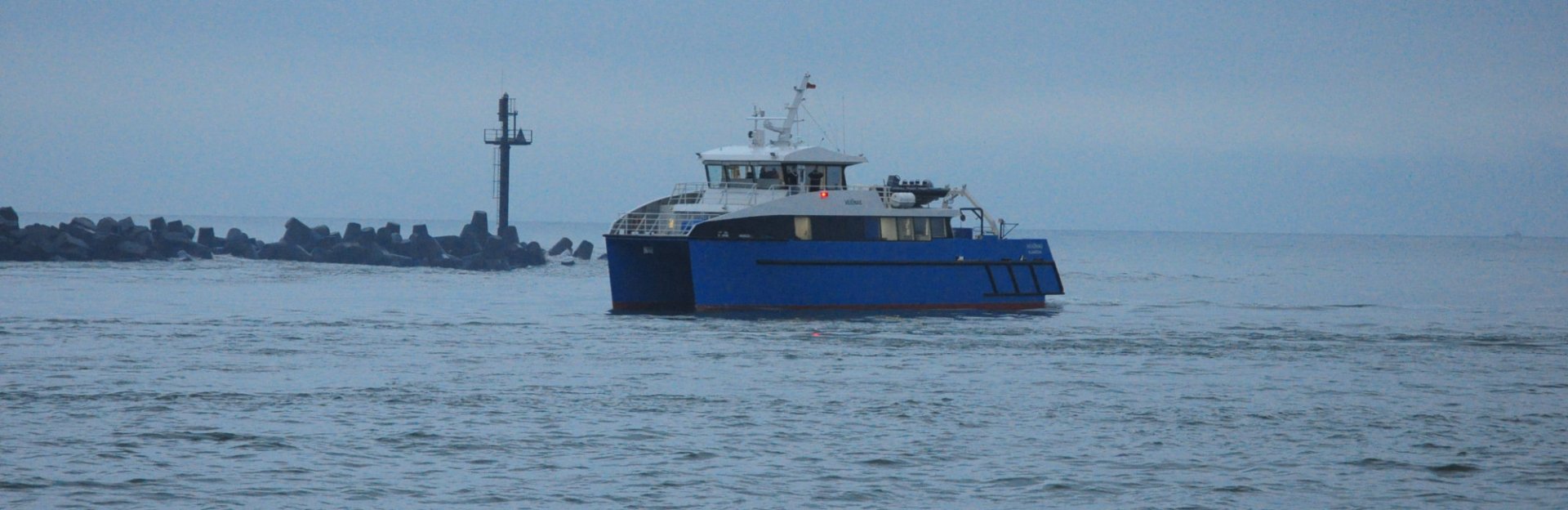
The research catamaran “Vėjūnas” was built in early 2012 at the Nasva shipyard in Estonia. This modern, 24-metre, shallow-draught vessel can carry out a wide range of scientific research work both in the Baltic Sea and in the Curonian Lagoon.
“Vėjūnas” is equipped with state-of-the-art research instruments (a CTD probe, an ADCP current profiler, an integrated water sampling system, a Van Veen grab sampler, a gravity sediment corer, a side-scan sonar, an echo sounder and a remotely operated underwater vehicle), which are essential for the national monitoring of the Curonian Lagoon and the Baltic Sea. Two winches installed on deck are used to lower measuring instruments into the water. The vessel also has a hydraulic crane used to deploy the Van Veen grab sampler and the gravity sediment corer.
The fixed CTD probe measures water salinity, temperature, oxygen, pH, chlorophyll-a and sound velocity in situ at different water depths. The on-board ADCP current profiler is used to determine flow velocity and direction precisely. Phytoplankton studies use an integrated sampling system that automatically collects water from different depths. The Van Veen grab sampler is used to collect surface sediment and benthos samples, while deeper sediment layers are retrieved with the gravity corer. The vessel is also fitted with a single-beam echo sounder for depth measurements, and a side-scan sonar is used to image the seabed structure and detect objects. As part of the shipbuilding project, the vessel was supplied with an RB Mini “MIRAGE” remotely operated underwater vehicle with an integrated Full-HD video camera. The ROV is used to film the seabed of the Curonian Lagoon and the Baltic Sea and can operate at depths of up to 300 m.
The vessel houses hydrology and chemistry–biology laboratories. The hydrology laboratory contains the computer systems that receive data from the CTD, ADCP, echo sounder, weather station and side-scan sonar. The chemistry–biology laboratory is fitted with a fume hood, refrigerators and freezers for storing samples during expeditions. Like the hydrology laboratory, it also has a computer system for entering data and transmitting it ashore via an internet connection.
“Vėjūnas” also carries a weather station measuring air temperature, wind speed and direction, atmospheric pressure, humidity and solar radiation. All meteorological data feed into the hydrology laboratory.
The vessel can operate autonomously for up to 3 days, so suitable living conditions are provided for the crew: five cabins, four of which are for crew members and one for the captain, as well as a small galley.
Technical data of the research vessel “Vėjūnas”
- Year of construction – 2012
- Displacement – 424 m³
- Length – 23.90 m
- Beam – 8 m
- Draught – 1.30 m
- Average speed – 11 knots
- Number of laboratories – 2
- Crew – 5
- Scientific team – 6–12
- Autonomy – 3 days
- Area of operation – Baltic territorial sea, Curonian Lagoon